

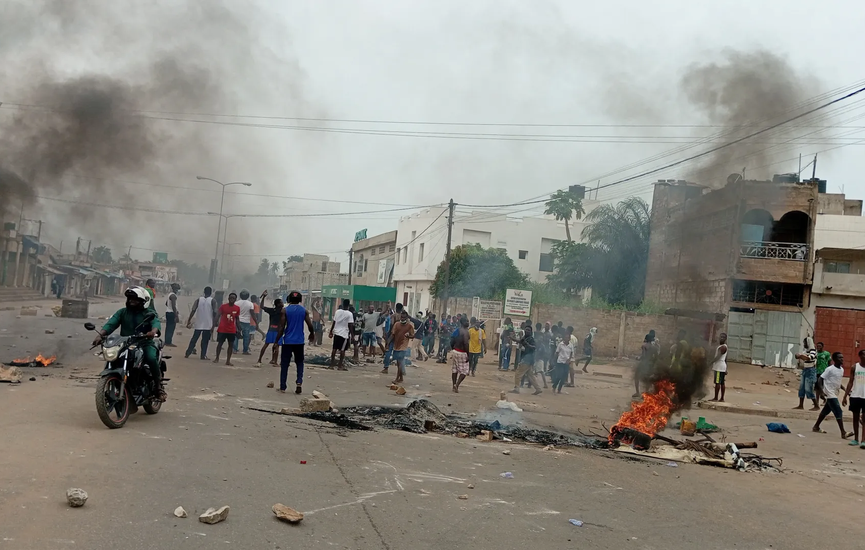
A newly adopted constitution in Togo has enabled long-time leader Faure Gnassingbé to transition into a powerful prime ministerial role, effectively bypassing presidential term limits — a move that has sparked public outrage and street protests in Lomé. Demonstrations are expected to continue this Friday.
In recent weeks, clashes with security forces have resulted in the deaths of at least five protesters.
However, it is not the traditional political opposition — which was overwhelmingly defeated in last week’s local elections — that has galvanized young Togolese citizens.
Instead, musicians, bloggers, and grassroots activists have become the leading voices of discontent, channeling widespread frustration and fatigue with a ruling family that has held power under Faure Gnassingbé and, before him, his father Gnassingbé Éyadéma, for nearly 60 years.
This dynastic hold on power surpasses even that of Cameroon’s 92-year-old President Paul Biya — who recently announced plans to seek an eighth consecutive term — and Gabon’s Bongo family, whose decades-long rule ended with a coup that ousted Ali Bongo in August 2023.
The events in Gabon appear to have influenced Faure Gnassingbé, a calculating and often low-profile leader, who swiftly orchestrated a constitutional overhaul aimed at extending his grip on power while minimizing perceptions of dynastic succession.
Under the new system, Gnassingbé, now 59, no longer needs to run for re-election under his own name. Instead, his authority comes from his Union pour la République (Unir) party’s dominance in the national assembly—a dominance maintained through electoral boundaries that disproportionately favor the ruling party’s support base in the north while diluting the influence of the opposition-heavy southern regions.
Togo’s Civil Service and Labour Minister Gilbert Bawara defended the legitimacy of the 2024 elections, asserting that "all the major political actors and parties" participated and that the government should not be blamed for the opposition’s weaknesses. In an interview with BBC Focus on Africa, he said lawful protests were permitted, and accused activists abroad of provoking youth to confront security forces and destabilize the country.
The revised constitution was introduced abruptly in early 2024 and swiftly ratified by the government-controlled legislature without seeking broader public consent through a referendum.
By May, the one-year transition period had ended. Gnassingbé stepped down from the presidency—after nearly two decades in the role—to assume the premiership, which now carries full executive authority, including command of the armed forces. The presidency, stripped of real power, was handed to 86-year-old former business minister Jean-Lucien Savi de Tové, whose role is now largely ceremonial.
Togo’s government portrayed its recent political restructuring as a transition from a dominant presidential system to a more democratic parliamentary arrangement—echoing the practices of Commonwealth nations. The shift came after Togo, along with Gabon, joined the Commonwealth in 2022, aiming to expand international ties and reduce dependence on its former colonial partner, France.
However, the international reaction was muted. With global attention absorbed by the conflicts in Gaza and Ukraine, Togo’s constitutional shift—widely seen as securing Faure Gnassingbé’s hold on power—went largely unnoticed abroad.
Even the Economic Community of West African States (ECOWAS) remained silent. This was despite the government pushing ahead with parliamentary elections just weeks after introducing the new constitution, in direct violation of ECOWAS rules requiring at least six months between major constitutional changes and national votes. Shaken by the recent withdrawals of Burkina Faso, Mali, and Niger, the bloc appears hesitant to criticize member states for fear of further fragmentation.
In contrast, the mood on the streets of Lomé was anything but quiet. Public anger intensified after rapper and vocal government critic Essowe Tchalla—better known as Aamron—posted a satirical video targeting Gnassingbé’s birthday on June 6. Shortly afterward, security forces detained him in a secret location, prompting mass protests among the capital’s youth.
The situation grew even more alarming when it was revealed that Aamron had been confined to a psychiatric hospital—echoing repressive tactics of past regimes. A video soon surfaced showing him claiming mental illness and expressing regret toward the president—statements he later disavowed after being released without formal charges. The protests reignited in late June, leading to violent confrontations with security forces, burning roadblocks, and reports of multiple fatalities. Two bodies were found in nearby lagoons, though it remains unclear whether they drowned while fleeing or were victims of targeted violence.
Figures like Aamron and the poet Honoré Sitsopé Sokpor (also known as "Affectio"), who was jailed earlier this year, have become symbols of youth resistance, channeling discontent in ways traditional political leaders have not. Faith in formal politics continues to wane: opposition leader Jean-Pierre Fabre remarked that no one else was present when he voted during the July 17 elections, which were officially won by the ruling Unir party.
To many Togolese, the new constitution represents not genuine reform but a strategic maneuver to extend the Gnassingbé family’s rule—described by some West African media as a "republican monarchy" or a form of "institutionalized authoritarianism."
A prominent human rights advocate in Togo says public anger has reached levels never seen before.
While the country has experienced major protests in the past, current tensions feel particularly intense.
Back in 2017, religious institutions backed street demonstrations calling for political reform, and a dynamic new opposition figure, Tikpi Atchadam, succeeded in rallying youth across central and northern regions—areas once considered loyal to the ruling regime.
During the 2020 presidential race, authorities were caught off guard by the strong showing of opposition candidate Agbeyomé Kodjo, who had the open support of the revered 89-year-old former Archbishop of Lomé, Philippe Kpodzro. Though both men have since passed away, the movement sparked by the late archbishop continues to remain vocal and is frequently targeted by state forces.
Now, discontent is once again spilling into the streets—especially among the country’s urban youth.
By introducing a new constitution dressed up as a shift to a "parliamentary" system, Faure Gnassingbé appears to be trying to maintain full authority while distancing his personal image from political conflict.
However, this tactic seems unlikely to succeed in the face of rising pressure from influential voices in popular culture—ranging from musicians to bloggers and grassroots activists.
The hashtag #FaureMustGo is gaining traction online, and a new civic initiative called M66, short for the “6 June Movement” referencing the president’s birthday, has recently emerged, signaling a fresh push for change.