

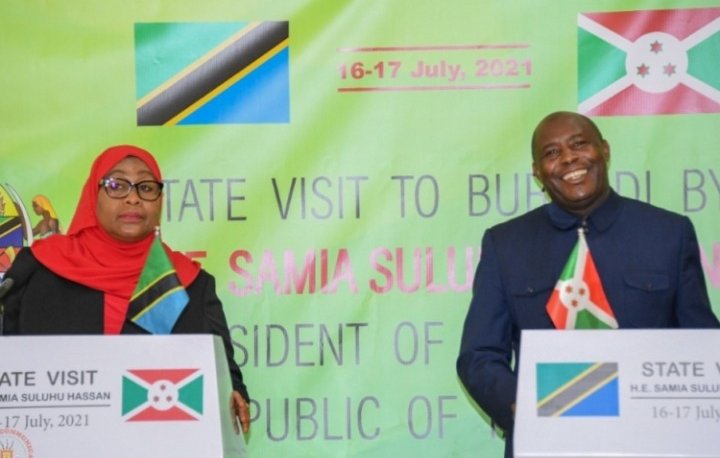
In an era where Africa is striving to unlock its full potential, few partnerships better exemplify the power of regional cooperation than the growing alliance between Tanzania and Burundi. Once defined mainly by shared history and geographic proximity, the relationship has evolved into a forward-looking collaboration focused on industrial growth, trade integration, and inclusive development.
At the center of this transformation is a bold, shared vision anchored in practical action and a belief in collective strength. A landmark initiative is the $2.15 billion Standard Gauge Railway (SGR) project, signed earlier this year. The 282-kilometre railway will link Uvinza in Tanzania to Musongati in Burundi, creating a vital trade corridor to the Indian Ocean. Once completed, the line is expected to significantly reduce transport costs, expand market access, and accelerate industrialization in both countries and the broader region.
Tanzanian President Samia Suluhu Hassan has described infrastructure projects like the SGR as more than logistical assets. For her, they are instruments of transformation—pillars of regional competitiveness, food security, and economic resilience. Tanzania’s investment in the Central Corridor reflects this commitment. As one of East Africa’s key logistics routes, the corridor aligns with the goals of the African Continental Free Trade Area (AfCFTA), offering landlocked nations a strategic outlet to international markets through Lake Tanganyika and beyond.
Trade imbalances persist across the region, particularly in the Democratic Republic of Congo’s eastern corridor, where rich reserves of minerals, timber, and agricultural goods remain underutilized. Imports still far exceed exports. Addressing this imbalance is vital to ensuring regional integration benefits all partners fairly and equitably.
Private sector engagement is adding momentum to this renewed cooperation. A prime example is the recent inauguration of a major fertiliser plant in Tanzania, built by Burundian company ITRACOM. Once fully operational, the facility will employ over 3,000 workers and sharply reduce dependence on imported fertiliser—an essential input in ensuring food security across the continent. Burundian President Évariste Ndayishimiye, who attended the launch, reflected on this shift, saying: “Burundians are no longer just coming to Tanzania as refugees; we are coming as investors.” His words mark a profound evolution in regional identity—from one shaped by displacement to one driven by economic empowerment.
This kind of cross-border investment reinforces Tanzania’s own fertiliser subsidy programme and supports its broader agricultural transformation goals. It also signals a maturing model of Pan-African cooperation based not on ideology alone, but on shared interests, local ownership, and results-driven collaboration.
However, serious challenges remain. Lake Tanganyika has risen by 2.5 meters in recent years the highest level in over half a century displacing communities and endangering infrastructure. Climate change, food insecurity, and cross-border security threats continue to affect the region, transcending national borders and requiring a united response.
Tanzania and Burundi have stepped up collaboration on several fronts: environmental protection, anti-terrorism efforts, counter-trafficking, and public sector capacity building. Tanzanian professionals are now supporting the training of Burundian civil servants, and new discussions are underway around joint agricultural ventures utilizing fertile Tanzanian land.
But unity is not forged by policy alone. It is built through shared experiences, cultural exchange, and human connection. As a symbolic gesture of this spirit, the Mount Kilimanjaro Challenge scheduled for December invites Burundians and friends of both nations to participate in a communal ascent of Africa’s highest peak. It is a celebration not just of natural beauty but of collective ambition. As the statement promoting the event declares, Kilimanjaro stands as “a metaphor for the climb we must take together.”
The Tanzania–Burundi partnership is showing what African-led cooperation can look like in action strategic, inclusive, and rooted in mutual trust. As the continent moves toward greater integration and economic self-determination, this alliance offers a model worth watching. Africa’s rise will not come through isolation, but through nations investing in one another, rising together toward a shared future.