

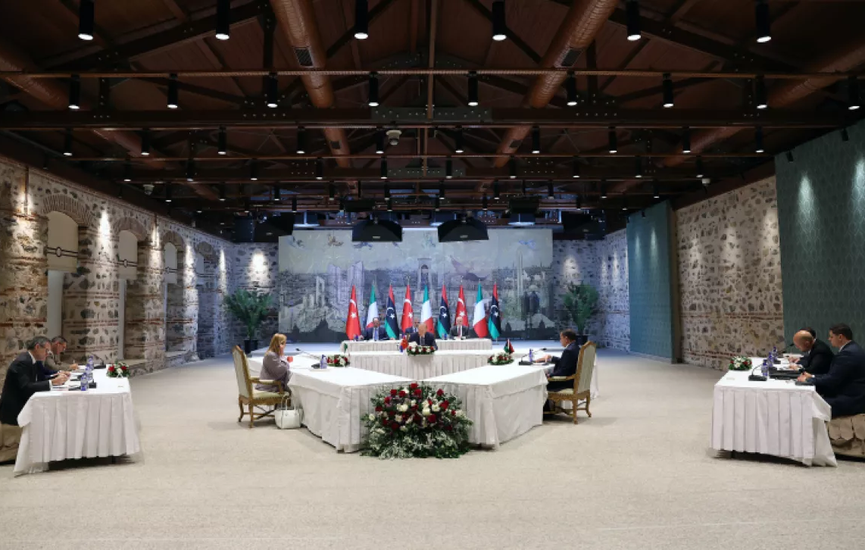
Turkey and Italy are deepening their strategic partnership in the Mediterranean, with a renewed focus on migration, energy, and regional influence, particularly in shaping Libya’s political future. At a joint press conference in Rome, Turkish President Recep Tayyip Erdogan and Italian Prime Minister Giorgia Meloni underscored their shared interest in stabilizing Libya, a country rich in energy resources but long plagued by conflict and political fragmentation. Their collaboration follows a tripartite summit with Libya’s Government of National Accord (GNA), signaling a growing alignment between the three nations.
While Turkey and Italy approach Libya with distinct priorities—Italy driven by migration concerns and Turkey by economic interests—both recognize the importance of a stable Libya in advancing their regional agendas. Italy, facing mounting pressure to curb irregular migration, views Libya as a critical gateway, while Turkey continues to support the GNA militarily and seeks to legitimize its rule amid criticism over its democratic record. Analysts suggest that Meloni’s endorsement of the Tripoli government offers a diplomatic lifeline, allowing it to maintain the status quo despite delayed elections.
Libya’s strategic location and vast energy reserves make it a focal point for both countries’ ambitions. Italy is increasingly positioning itself as a Mediterranean power with growing interest in African partnerships, while Turkey is leveraging its historical ties and economic pragmatism to expand its influence. The legacy of colonialism shared by both nations in Libya adds a layer of complexity to their engagement, but also provides a foundation for renewed cooperation. With Russia scaling back its support for eastern strongman Khalifa Haftar due to its war in Ukraine, Ankara sees an opening to engage with eastern factions, notably through Haftar’s son Saddam, who has made frequent visits to Turkey.
This shift in Turkish strategy—from military confrontation to economic diplomacy—has begun to reshape alliances. Saddam Haftar’s pro-Turkey stance reflects a generational change in Libya’s eastern leadership, one that favors pragmatic engagement over conflict. Turkey’s willingness to offer sanctuary to Libyans during the 2011 uprising has earned it lasting goodwill, which it now leverages to build bridges across Libya’s political divide. As Ankara reaches out to the east, and as eastern leaders seek stability and investment, a new chapter in Libya’s future may be unfolding—one shaped not by force, but by strategic cooperation.
Turkey’s growing influence is also reflected in its outreach to Egypt, a longtime backer of Haftar’s eastern government. Recent talks between Turkish Foreign Minister Hakan Fidan and Egyptian President Abdel Fattah el-Sisi suggest a thaw in relations and a shared interest in Libya’s stability. Analysts believe that Turkey’s business-driven approach and its ability to adapt tactically have positioned it as a dominant player in Libya’s evolving landscape. With Italy now joining forces, the two Mediterranean powers are poised to redefine the region’s balance, potentially steering Libya toward a more unified and economically integrated future.