

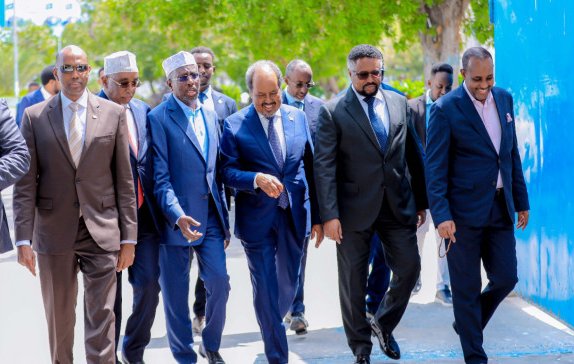
In a landmark move that could reshape Somalia’s political landscape, President Hassan Sheikh Mohamoud and four prominent opposition leaders have signed a pivotal agreement outlining the framework for the country’s upcoming elections. Finalized on August 25, 2025, the accord marks a significant step toward implementing universal suffrage in the 2026 elections, following the adoption of a new electoral law by Parliament in October 2024. This law replaces Somalia’s longstanding indirect clan-based voting system with a more inclusive, citizen-driven model—an ambitious reform that has sparked both hope and controversy.
President Mohamoud hailed the agreement as a breakthrough, declaring, “The doors to state reconstruction are now open,” after two months of intense negotiations. The agreement stipulates that while the President will continue to be elected by Parliament, Members of Parliament themselves will be chosen through direct voting by the public. This shift toward a "one person, one vote" system is seen by many as a bold stride toward democratic consolidation in a country long plagued by political fragmentation and insecurity.
Under the new framework, political parties that secure at least 10% of parliamentary seats will receive official recognition, a move designed to encourage broader political participation and strengthen institutional legitimacy. All signatories have pledged to support the transition to universal suffrage, signaling a rare moment of consensus in Somalia’s often fractious political arena.
Yet, the agreement has also laid bare deep divisions within the opposition. While some leaders have embraced the reform as a necessary evolution, others remain staunchly committed to the clan-based system, arguing that it better reflects Somalia’s complex social fabric. Former President Sherif Sheikh Ahmed has emerged as a vocal critic, warning that the country’s fragile security environment may not be conducive to such sweeping changes. His concerns underscore the challenges that lie ahead for President Mohamoud, who must now navigate a fragmented opposition while steering Somalia toward a more democratic future.
As Somalia stands at a crossroads, the success of this electoral transition will hinge not only on political will but also on the ability to foster trust, ensure security, and engage citizens in shaping their nation’s destiny. The coming months will be critical in determining whether this agreement becomes a turning point—or another chapter in Somalia’s long struggle for stability and democratic governance.